

In recent years, language models (LLMs) have significantly changed the way we interact with technology. They are becoming increasingly capable: they generate text and code and help with decision-making and so on. But there is a problem when we try to apply them in a real-world environment like connecting them to external systems, data and tools.
That’s where the Model Context Protocol (MCP) comes in.
We’ll explain in simple terms what MCP is, how it works in practice, and why it is becoming increasingly important in the development of AI. We’ll also look at how it enables models to work with real-world context, use external tools, and carry out actions in a more controlled way.
We’ll also discuss some use cases, advantages and limitations, and how all this fits in with the rise of agent-based systems.
Introduction
AI has made huge strides in a very short space of time. Today, we have models that write code, generate content or help us solve quite complex problems.
But as soon as we try to use them for something ‘real’ (a product, an internal process, a business tool), we quickly realise something: the model on its own falls short.
It needs to access real data, integrate with systems and be able to take action, not just respond.
And that’s where it starts to make sense to talk about the Model Context Protocol (MCP).
What is the Model Context Protocol (MCP)?
The MCP is, basically, a way of organising how an AI model connects with the outside world – that is, what information it receives, what tools it can use and how it carries out actions.
Without MCP (or something similar), each integration tends to be somewhat ‘tailor-made’: specific logic, complex prompts, things that are difficult to maintain. This protocol aims to organise all of that; it defines a sort of clear contract between the model and external systems, so that everything is more reusable and easier to scale.
How does MCP work in practice?
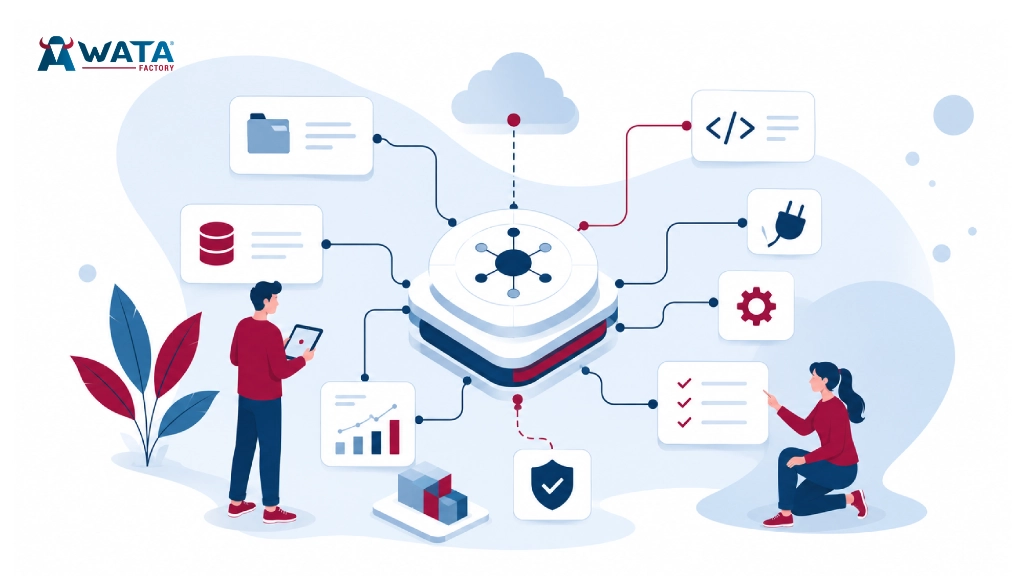
To put it very simply, MCP introduces a layer between the model and the other systems. And that layer organises three key elements:
1. The context
The model no longer works solely with a single prompt, but with richer information such as user data, application status, history, results from other tools, etc.
2. The tools
This is where it gets interesting. The model can use things such as: APIs, databases, internal functions and even development tools, but not ‘haphazardly’ – each tool is defined with clear inputs and outputs.
3. Execution
The model does not execute actions directly. It suggests using a tool, and the system decides whether to run it; this allows us to maintain control, validate actions and log everything that happens.
And this is key in a business context.
In practice, although MCP may appear to be just another layer within the architecture, its real value lies not so much on the server side as in how it changes the way AI models work. Thanks to this approach, the model ceases to be an isolated component that merely responds to prompts, and instead becomes part of a much more interconnected system. In other words, we are no longer just talking about generating text, but about understanding context, deciding which tools to use and actively participating in real workflows within an application.
Use cases where it really adds value
This isn’t just theory. MCP starts to make sense when we see it in action:
1. Development copilots
In an IDE, for example, the model can read our actual code, understand the project, suggest context-aware changes and even apply refactorings and generate new code.
It’s no longer just a matter of ‘providing a snippet’; it’s about working on our actual code.
2. Automation in business
And this is where the greatest value lies, because we can automate day-to-day tasks such as querying internal databases, generating reports, and managing and integrating with tools such as CRMs.
Everything is connected, not isolated.
Another of the most important use cases right now is that agents not only respond, but also chain together actions and decisions using various tools, drawing on real-world context because they’re connected via MCP; it therefore fits very well for building fully intelligent systems
Advantages of MCP (in the real world)
Beyond the theory, the benefits are quite clear:
- Less ‘glue’ between systems: We don’t have to reinvent every integration.
- Greater control: We know what the model does and when it does it.
- Better scalability: Adding new tools doesn’t break everything.
- Better context = better results: The model stops ‘guessing’ so much.
- It fits with the direction AI is heading: particularly with agents and automation.
Limitations (because not everything is perfect)
It’s also worth noting: it’s not magic.
- It needs to be designed properly: If we define the context or the tools incorrectly, it won’t work.
- Not everyone is using it yet: It’s still being adopted.
- It depends on the ecosystem: the more tools that support it, the better.
- Too much context can be counterproductive: more isn’t always better.
Why is it important right now?
Because we have reached a point where AI is no longer merely ‘answering questions’; it has advanced sufficiently to operate with a high degree of autonomy in controlled environments, and this means we want it to interact with real-world systems, automate tasks, make context-aware decisions without requiring our attention, and carry out specific actions that add value to the problem we are seeking to solve – all of this with the level of autonomy that AI currently possesses and will continue to possess in the future.
Conclusion
MCP is not so much a ‘trendy’ technology as a component that is starting to become essential.
If we want an AI model to do more than just respond to prompts, we need a way to integrate it properly with the rest of the system. And that’s where MCP adds value.
It’s probably not the only solution we’ll see, but it does give a pretty good indication of the direction in which AI architectures are evolving.
At WATA Factory, we find this sort of approach particularly interesting because it’s exactly in line with what we’re building.
Increasingly, projects are not just about using a model, but about integrating it effectively with real-world systems. And that’s where things like MCP make all the difference.
It allows us to design solutions that are more connected, more useful and, above all, more maintainable in the long term.